Bharatiya Jan Sangh at 75
From fringe to centre stage of a political theatre
by Somen Sengupta
Frontier Web dated 15th March 2026
To understand ways to combat the Hindu nationalist majoritarianism of the present day BJP, it is important that we know of its history. This article
has been published to offer a chronicle on how the party came to enact political vision of Hindu nationalism within the structure of democracy. -
Ed.
In India’s political history, Akhil Bharatiya Jan Sangh, the first major ultra-national political party founded after independence, occupies a place of
paramount importance. It goes down in history with the rare distinction of being a political entity which was active for only 26 years but was
reborn under a different name with almost the same legacy to turn around India’s theatre of political power. Bharatiya Jana Sangh, or BJS, was born
out of the political agenda of a non-political organization, the personal ambition of a high-profile politician, and of course the collective anger and
aspiration of a section of common people who had seen their social, religious, and economic positions deprived under the newly formed Congress
Government of free India.
On 30th January 1948, a Hindu Maratha named Nathuram Godse, who had a strong social and political connection with RSS and Hindu Mahasabha,
assassinated Mahatma Gandhi, backed by his own decision.
The killing of an icon like Gandhi changed the direction of Indian politics. It on one hand cemented Gandhi as one of the tallest icons in the
history of mankind and at the same time it ruined the prospect of Hindu nationalistic politics in India which had huge potential to challenge the
Nehru Government.
Thanks to the adverse public sentiment following the conduct of Godse and what the government termed as necessary action, the Nehru
Government went on to ban RSS with large-scale arrests and detention, three important political personas found themselves devastated. Vinayak
Savarkar of Hindu Mahasabha and Madhav S. Golwalkar were both arrested under suspicion of involvement in this murder. The person who was in
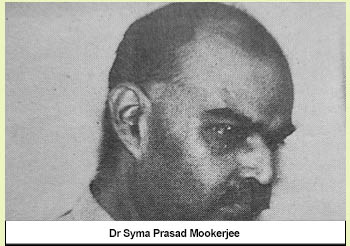
the most embarrassing and suffocating situation was Dr. Syama Prasad Mookerjee, a HMS leader who was then a cabinet member in Nehru's
Government.
Savarkar, who was once an inspiration to many nationalists and later became associated with Hindu nationalism, was arrested under suspicion of
direct involvement in the Gandhi assassination case. He was old, sick, and by then almost withdrawn from active politics, with no ambition left. He
by then had strong differences with Golwalkar and also with Dr. Mookerjee on many accounts. Savarkar after his arrest put all his effort into
clearing himself from the case, and he indeed was acquitted in 1949. Golwalkar, the second Sarasanghachalak of RSS, an organization claiming no
connection with politics, was devastated most to find himself in jail and seeing his organization under the claws of the Government. In the early
1940s, his dream of seeing India as a Hindu Rashtra did not materialize with HMS under Savarkar, thanks to the vast gap in their ideological
thoughts.
 Though Golwalkar possessed organizational capacity and communication skills in Hindi, Marathi, Bengali, and English, he, due to his RSS
background, was never at par with Savarkar in the public domain. Savarkar, who kept himself away from many superstitions, found himself misfit to
blend with Golwalkar's spiritual and radical thoughts of Hindu nationalism. Thus the marriage of RSS and HMS was never possible till the time
Savarkar was heading the latter. Though Golwalkar possessed organizational capacity and communication skills in Hindi, Marathi, Bengali, and English, he, due to his RSS
background, was never at par with Savarkar in the public domain. Savarkar, who kept himself away from many superstitions, found himself misfit to
blend with Golwalkar's spiritual and radical thoughts of Hindu nationalism. Thus the marriage of RSS and HMS was never possible till the time
Savarkar was heading the latter.
Dr. Mookerjee, who took over the presidency of HMS from Savarkar, was a noted educationist from Calcutta and took up the cause of Bengali
Hindus suffering from various atrocities of the Muslim League before partition and in East Pakistan after partition. He was a known face in national
politics from Bengal after Netaji Bose, and by mid-1947 he was recommended by none other than Mahatma Gandhi to be a part of Jawaharlal
Nehru's first cabinet. When Gandhi was killed, Mookerjee was still in HMS and, seeing the drastically adverse sentiment of public and media, he
silently left the party by the end of 1948.
However, he kept on fighting with the Government for partition-ravaged Hindus of Punjab, Bengal, and Assam. Even when a member of Nehru's
cabinet, he was often vocal for Hindus and never felt shy to castigate Nehru's Muslim appeasement policies. It was very clear that Dr. Mookerjee
had his own political agenda against the Congress Government, and sooner or later he would play his right card to launch himself against Nehru.
Dr. Mookerjee was one of the members of the first Nehru cabinet.
Golwalkar meanwhile managed to set himself free from jail with an unofficial declaration to the Government that RSS would never involve itself in
politics. By the time he came out of jail, his dream of becoming an apostle of Hindu Rashtra, where he would be a mentor of key policies without
holding a Government office, was reduced to dust, and like Dr. Mookerjee he was also waiting for a perfect moment to strike back.
Dr. Mookerjee, after a stormy debate, resigned from Nehru's cabinet in April 1950 in protest of the Delhi Pact signed between India and Pakistan in
the context of protecting minorities in their respective countries. Dr. Mookerjee, who had advocated for a complete exchange of population in the
case of Bengal in line with Punjab, found this agreement suicidal for Hindus living in East Pakistan. Dr. Mookerjee, after resigning, came back to
Calcutta where he was given a reception in many places. It was clear to India that a new era was slowly unfolding in Indian politics.
 As Savarkar's HMS failed to come together with Golwalkar's RSS, the resignation of Dr. Mookerjee had reasons to cheer up many Hindu nationalists.
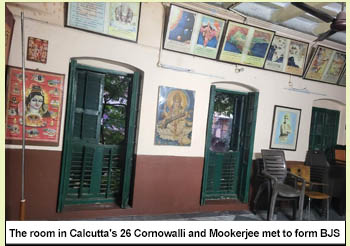
Golwalkar and Dr. Mookerjee soon met at the 3rd floor of an old building situated at Calcutta's 26 Cornwallis Street, where the idea of forming a
new political party was born. In that meeting, Dr. Mookerjee was requested by Golwalkar to form a political party to protect Hindu interest, and
every possible support in building an organizational network was promised by RSS. At this meeting, Golwalkar offered four swayamsevaks to
Mookerjee to build the party. They were Deen Dayal Upadhyay, Nanaji Deshmukh, and Sunder Singh Bhandari. As Dr. Mookerjee was not proficient
in Hindi, he was given a personal secretary to handle his office communications. He was Atal Behari Vajpayee. As Savarkar's HMS failed to come together with Golwalkar's RSS, the resignation of Dr. Mookerjee had reasons to cheer up many Hindu nationalists.
Golwalkar and Dr. Mookerjee soon met at the 3rd floor of an old building situated at Calcutta's 26 Cornwallis Street, where the idea of forming a
new political party was born. In that meeting, Dr. Mookerjee was requested by Golwalkar to form a political party to protect Hindu interest, and
every possible support in building an organizational network was promised by RSS. At this meeting, Golwalkar offered four swayamsevaks to
Mookerjee to build the party. They were Deen Dayal Upadhyay, Nanaji Deshmukh, and Sunder Singh Bhandari. As Dr. Mookerjee was not proficient
in Hindi, he was given a personal secretary to handle his office communications. He was Atal Behari Vajpayee.
Dr. Mookerjee personally contacted all his friend politicians in other parties like Congress, Praja Socialist Party, HMS, etc., and got a response. He and
RSS workers toured the entire country to make enough provisions for organizational machinery and funds. Initially, the name of the party was
thought to be All India People's Party or Young India Party, but RSS wanted an Indian name that sounded very different from English names like
Congress, Communists, or Socialists. Finally, after much debate, Bharatiya Jan Sangh was finalized.
From April to October 1951, many states like Rajasthan, Punjab, Bengal, UP, Delhi, etc., formed state-level BJS parties, and from the beginning Nehru
and other Congress leaders started labelling it as a communal organization even without knowing its policy and objectives. Finally, on 21st October
1951, at Raghomal Arya Kanya High School of Delhi, in the presence of 2000 people and 500 active members from many corners of India, the first
Hindu nationalistic party of independent India was officially launched. Lala Balraj Bhalla proposed the name of Dr. Syama Prasad Mookerjee as its
founder President.
Dr. Mookerjee delivered his presidential speech in Hindi and avowed that this new party would become a clear alternative to Nehru-led Congress,
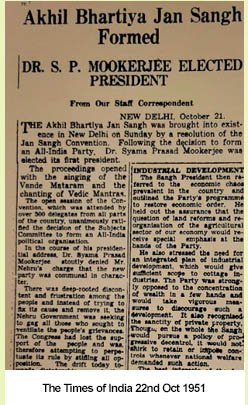
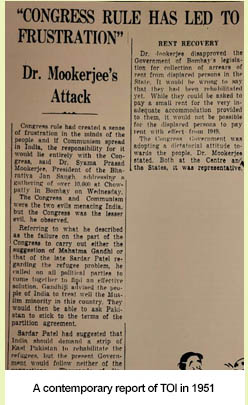
which was now a subject of deep-rooted discontent and frustration among people. As reported by The Times of India dated 22nd October,
Mookerjee charged that the "Nehru Government was seeking to gag all those who sought to ventilate the people's grievances. The Congress had
lost the support of the people and was therefore attempting to perpetuate its rule by stifling all opposition."
Dr. Mookerjee did not mention any agenda of Hindu Rashtra; rather, he clearly said that the door of the party was open to all Indians irrespective of
their religion, caste, and creed. The party would stand for equal rights of all minorities, and special interest would be taken to protect all backward
and downtrodden sections. He praised Nehru as a human being and statesman and alerted all members of BJS not to make any personal attack on
him.
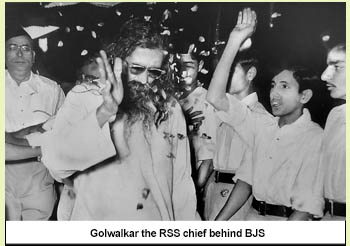 He mentioned that BJS is against concentration of wealth in few hands. It believes in integrated industrial development with enough scope for
cottage industries. The party opposed the Kashmir policy of India and demanded unconditional integration of the state with the Indian nation.
Dr. Mookerjee hoped that soon BJS would become the main opposition party. However, in the first election of 1952, BJS fared badly. It got 3.06% of
the vote with just three seats. Dr. Mookerjee himself was elected from the South Calcutta seat. Out of its three seats, 2 came from Bengal and 1 from
Rajasthan. Surprisingly enough, states like Gujarat, UP, Delhi, Maharashtra, which are now strong centres of Hindu nationalistic politics, did not elect
a single BJS candidate. Dr. Mookerjee unofficially became the main opposition leader in Parliament. He engaged in debates castigating the Nehru
Government. In Parliament, he became known to many young members. He mentioned that BJS is against concentration of wealth in few hands. It believes in integrated industrial development with enough scope for
cottage industries. The party opposed the Kashmir policy of India and demanded unconditional integration of the state with the Indian nation.
Dr. Mookerjee hoped that soon BJS would become the main opposition party. However, in the first election of 1952, BJS fared badly. It got 3.06% of
the vote with just three seats. Dr. Mookerjee himself was elected from the South Calcutta seat. Out of its three seats, 2 came from Bengal and 1 from
Rajasthan. Surprisingly enough, states like Gujarat, UP, Delhi, Maharashtra, which are now strong centres of Hindu nationalistic politics, did not elect
a single BJS candidate. Dr. Mookerjee unofficially became the main opposition leader in Parliament. He engaged in debates castigating the Nehru
Government. In Parliament, he became known to many young members.
Dr. Mookerjee died in custody in Srinagar in June 1953. His death created reaction in the country, and in Calcutta his funeral procession saw
significant turnout. However, with his death, the influence of BJS in Bengal was totally wiped out and CPI became the main voice of opposition
against the ruling Congress party.
Golwalkar was never strong enough to influence Dr. Mookerjee, and the same happened with the next President, Mauli Chandra Sharma, who also
resigned in frustration on 3rd November 1954, showing acute differences with RSS.
BJS had Premnath Dogra, a Jammu-based politician, and Acharya Deb Prasad Ghosh, a Math professor of Calcutta's Rippon College, as the next two
Presidents. Both were non-RSS men, and Golwalkar did not disturb them much to capture the party. But from this time till 1965, three RSS men—
Balraj Madhok, Deendayal Upadhyay, and Atal Behari Vajpayee—became the key figures behind the President.
From 1965, as soon as Madhok and Upadhyay both became President at a short gap, BJS practically became an extension of RSS with no direct onus
on Nagpur. Deen Dayal died on 11th February 1968 in an accident on a train. After that, Vajpayee took over. His lobby expelled Madhok from BJS in
1973. In the same year, Golwalkar died. Vajpayee took BJS partly out of RSS grip with the help of LK Advani, Jagannath Rao Joshi, Brijlal Verma, Bhairon
Singh Shekhawat, etc.
Meanwhile, in the 1957 election, BJS got only four seats while CPI got 27 and Praja Socialist Party got 19 seats. Congress stormed back to power with
371 seats.
 In the 1962 election, held before the India–China war, BJS got 14 seats with 6.44% of the vote. All of its seats came from the Hindi-speaking region of
UP, MP, Delhi, Rajasthan, and that part of Punjab which later became Haryana. It performed best in the 1967 election with 35 seats and nearly 9% of
the vote. Congress under Indira won 283 seats, the thinnest ever for Congress. By the end of the 1960s, BJS had become stronger in the Hindi belt
but was still a marginal force in Maharashtra, Bengal, Assam, and Gujarat. In the 1962 election, held before the India–China war, BJS got 14 seats with 6.44% of the vote. All of its seats came from the Hindi-speaking region of
UP, MP, Delhi, Rajasthan, and that part of Punjab which later became Haryana. It performed best in the 1967 election with 35 seats and nearly 9% of
the vote. Congress under Indira won 283 seats, the thinnest ever for Congress. By the end of the 1960s, BJS had become stronger in the Hindi belt
but was still a marginal force in Maharashtra, Bengal, Assam, and Gujarat.
BJS failed to establish a presence in any South Indian state, though it organized three national conventions in the south between 1957 and 1967.
Indira Gandhi was back to power with a higher majority in 1971, and BJS was reduced to only 22 seats.
From 1973, LK Advani took over the party as President. It was a time when the spectrum of Indian politics started changing with the end of
Congress monopoly to enjoy power. With the imposition of Emergency in June 1975, the state machinery of Indira Gandhi led many to believe that
the Indian democratic system was in crisis and there was a need for a united opposition force to dethrone her.
Thus, Janata Party was formed with almost all anti-Congress parties except the Left. There was serious objection from many leaders to including BJS
for its advocacy of Hindutva, strongly backed by RSS. However, Jay Prakash Narayan, who was critical of RSS earlier, allowed BJS to join Janata Party.
There was a demand for BJS leaders to give up membership of RSS.
At this point, BJS leaders did a strange thing. They all kept RSS membership but dissolved BJS itself on 23rd January 1977 to merge into Janata Party.
So officially, Bharatiya Jan Sangh, a party formed by Syama Prasad Mookerjee and Golwalkar in 1951, finally ended under LK Advani and Vajpayee in
1977.
The election of 1977 threw Indira Gandhi out of power.
Janata Party got 295 seats, out of which 93 were won by people associated with BJS and RSS. Morarji Desai invited three former BJS members (all
former RSS members too) to join his cabinet. For the first time, individuals aligned with the political vision of Dr. Syama Prasad Mookerjee and
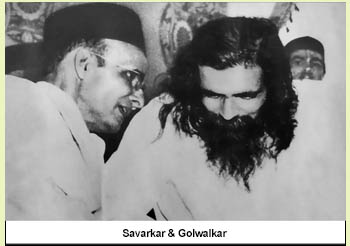 Madhav Golwalkar became part of the power corridor of Delhi, though not in full form. Madhav Golwalkar became part of the power corridor of Delhi, though not in full form.
The Janata Party Government collapsed in 1979, and in the election of 1980 Indira Gandhi returned to power. Janata Party won only 31 seats, and out
of those, 16 were won by members of BJS-RSS origin.
As this created insecurity inside the Janata Party, leaders like Jagjivan Ram, Chandra Shekhar, etc., again demanded the discarding of RSS
membership by all former BJS leaders.
From 1968 itself, BJS was slowly coming out of the RSS shadow, and RSS's new Sarasanghachalak, Balasaheb Deoras, was pushing his organizational
ideology more towards the newly formed Vishva Hindu Parishad than BJS. Still, in 1980, former BJS leaders in Janata Party refused to give up their
RSS membership.
Rather, they left Janata Party to bring about a re-emergence of BJS in a new political party.
On 6th April 1980, with many new members, BJS was reborn as Bharatiya Janata Party. The old name BJS was rejected by most of the members.
BJP had its first national conference in Bombay in December 1980. The new party, headed by Atal Behari Vajpayee, adopted a Gandhian school of
socialism as its objective, which was castigated by many members like Rajmata Vijayraje Scindia and Kailash Narang. Such disagreement was
created in the meeting that BJP had to explain that its socialism was not in line with Marx but with Deendayal. The party officially kept a distance
from hardcore, radical Hindutva and, to signal this shift, decorated its centre stage with photos of both Dr. Mookerjee, Deen Dayal, and Jayaprakash
Narayan. It invited several Muslim citizens to join the party, along with professionals in other fields. The party publicly accepted the secular
credentials of the Indian constitution without discarding its old demands like a uniform civil code, abolishment of Article 370, etc. In a nutshell, BJS
was reborn as BJP with its vintage legacy but under a different approach to Hindu nationalism.
Click here to view the original article
|